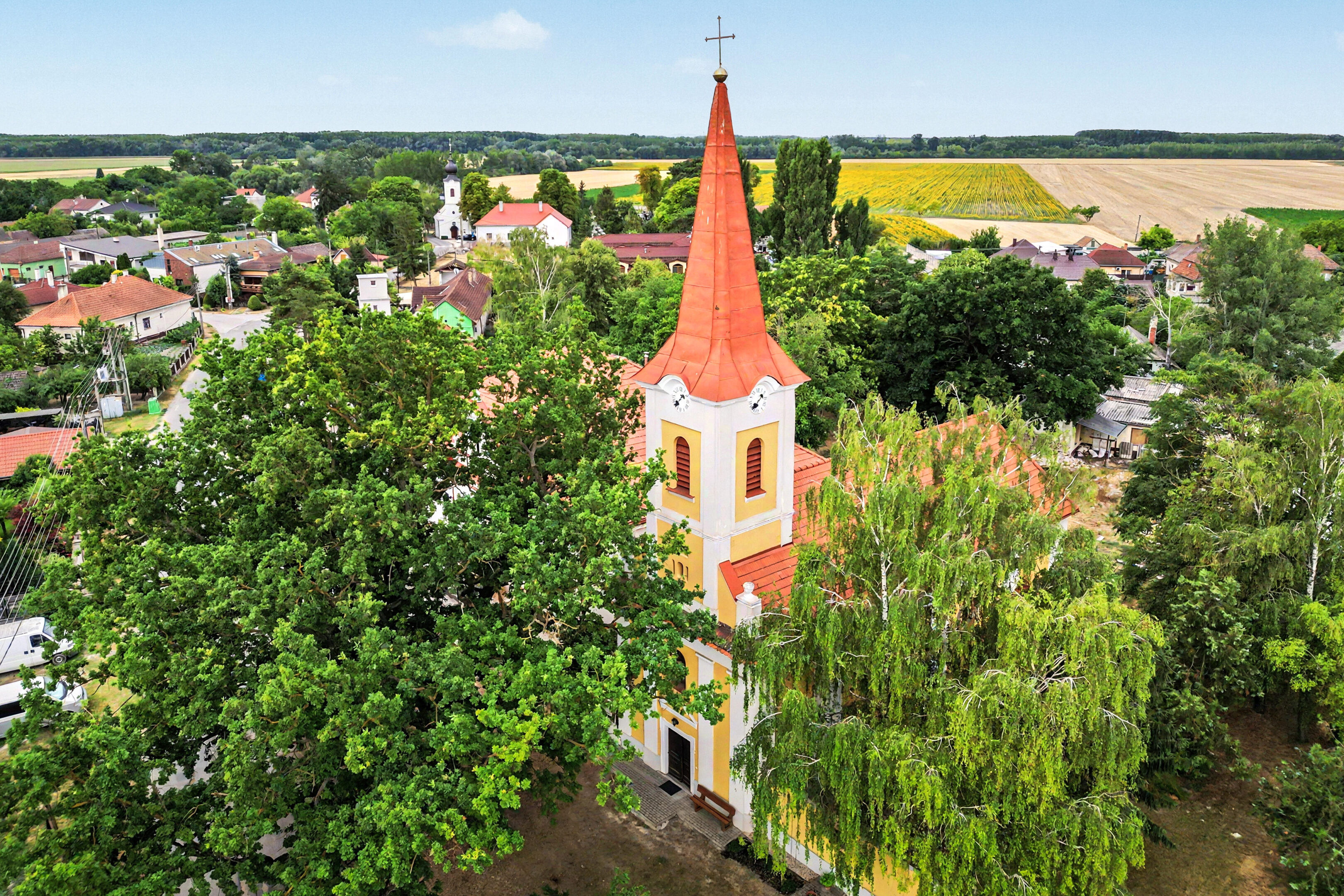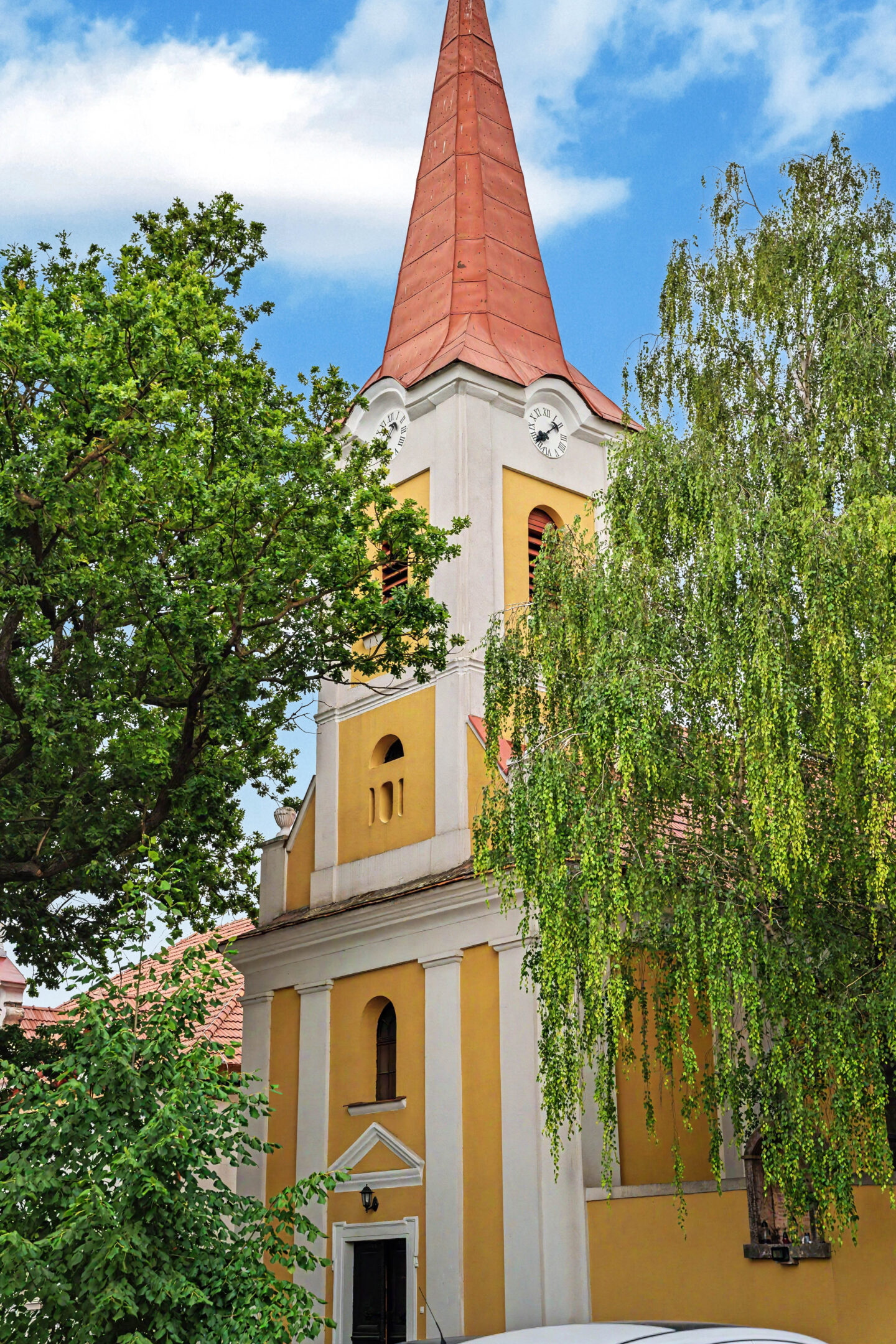



The late Renaissance Roman Catholic Church of the Assumption of the Virgin Mary was built by the Zichy family in 1673 on the site of the demolished Calvinist church and after the completion of the manor house. Originally the church did not have a tower, apparently there was a bell tower. At the end of the 18th century, the building was rebuilt in a classical style, with a tower built into the facade. Later the building was only repaired.
Today’s Classicist Roman Catholic Church of the Assumption of the Blessed Virgin Mary was built at the end of the 18th century on the site of an older early Baroque church from the second half of the 17th century. The church is a single-nave space with a segmental capped presbytery, with a tower built into the front, an attached sacristy and a side chapel, originally forming a transept and oratory for the manse.
The church was directly connected to the former monastery, the former oratory with a higher floor level is now in emergency use. In the former oratory there is a ceiling painting of St. John Bosco from 1928 by J. Datelink. The main altar, dating from around 1800, has a wooden classical tabernacle and an altarpiece of the Assumption of the Virgin Mary from the first half of the 19th century. On the sides are gilded sculptures of cherubs.
In the side chapel there is an altar with a wooden cross with a polychrome body. The wooden pulpit with a resonant canopy and gilding, the red marble baptismal font on a round leg and the red marble communion cups are from the early 19th century. On the choir is a newer organ imported here in 1995. In the church there is a commemorative plaque of the wedding of Count Johann Waldstein-Wartenberg to Countess Theresa Zichy on 17 February 1844 and to Countess Adele Kálnoky on 18 November 1871.
Epitaph of Count István Zichy’s sons and sister. Metal memorial plaque in memory of Count Sándor Kálnoky, patron of the parish, and his wife. The large bell dedicated to Our Lady, the Patroness of Hungary, was cast by the Roman Catholic faithful of Čičov in 1922 by Richard Herold in Komotau (Chomutov), the small bell was cast by Gaspar Mendel in Györ in 1802.
Galéria