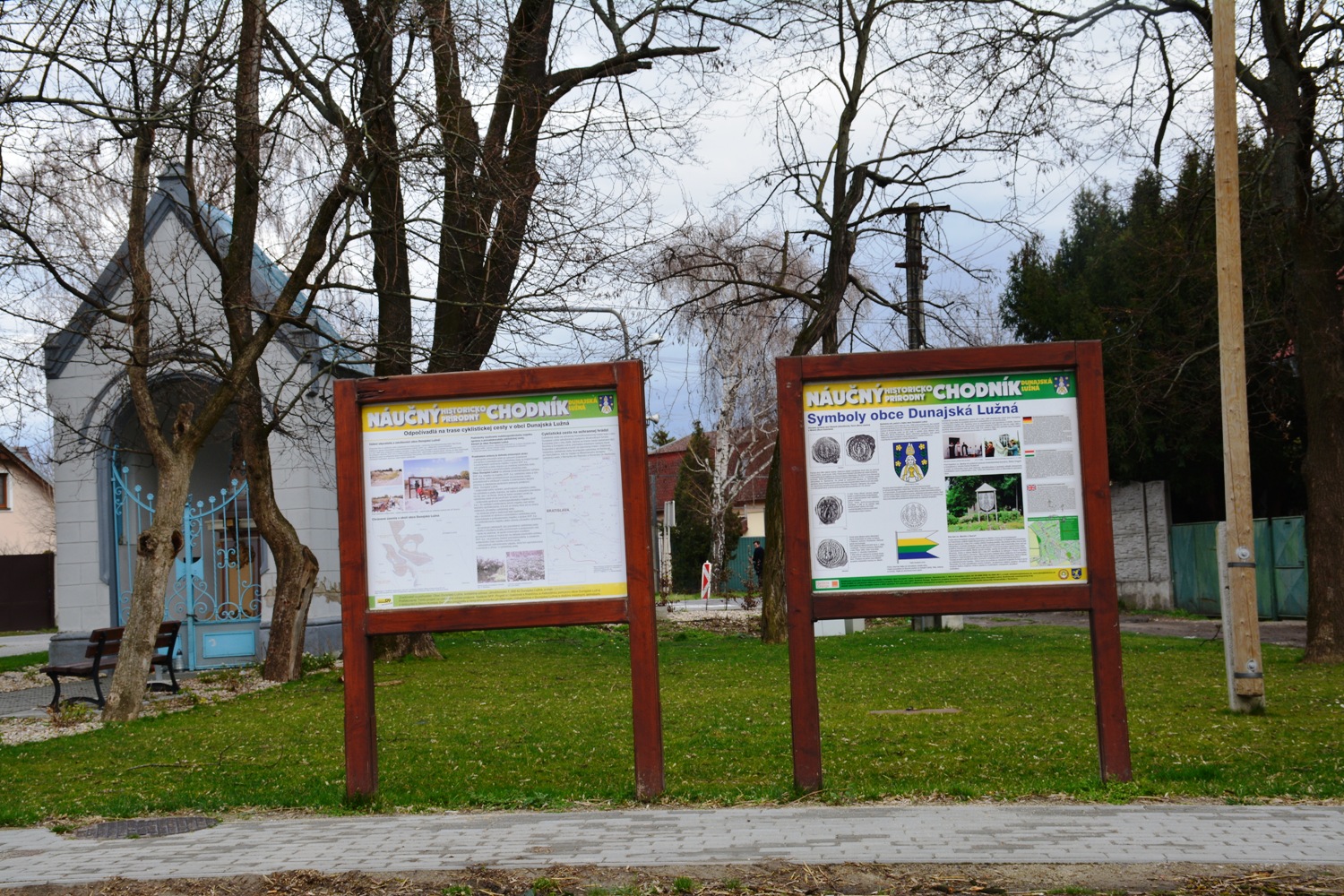
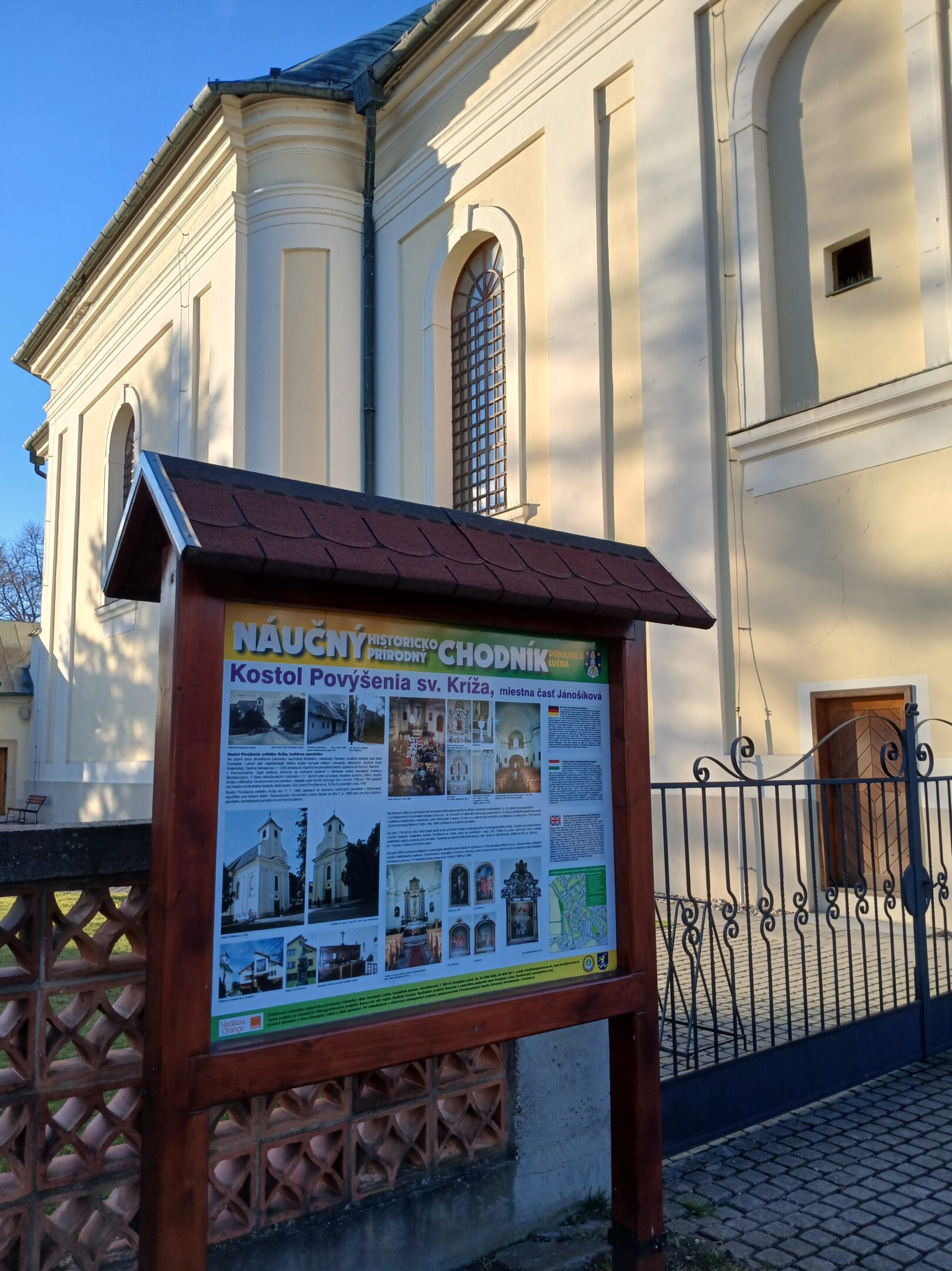
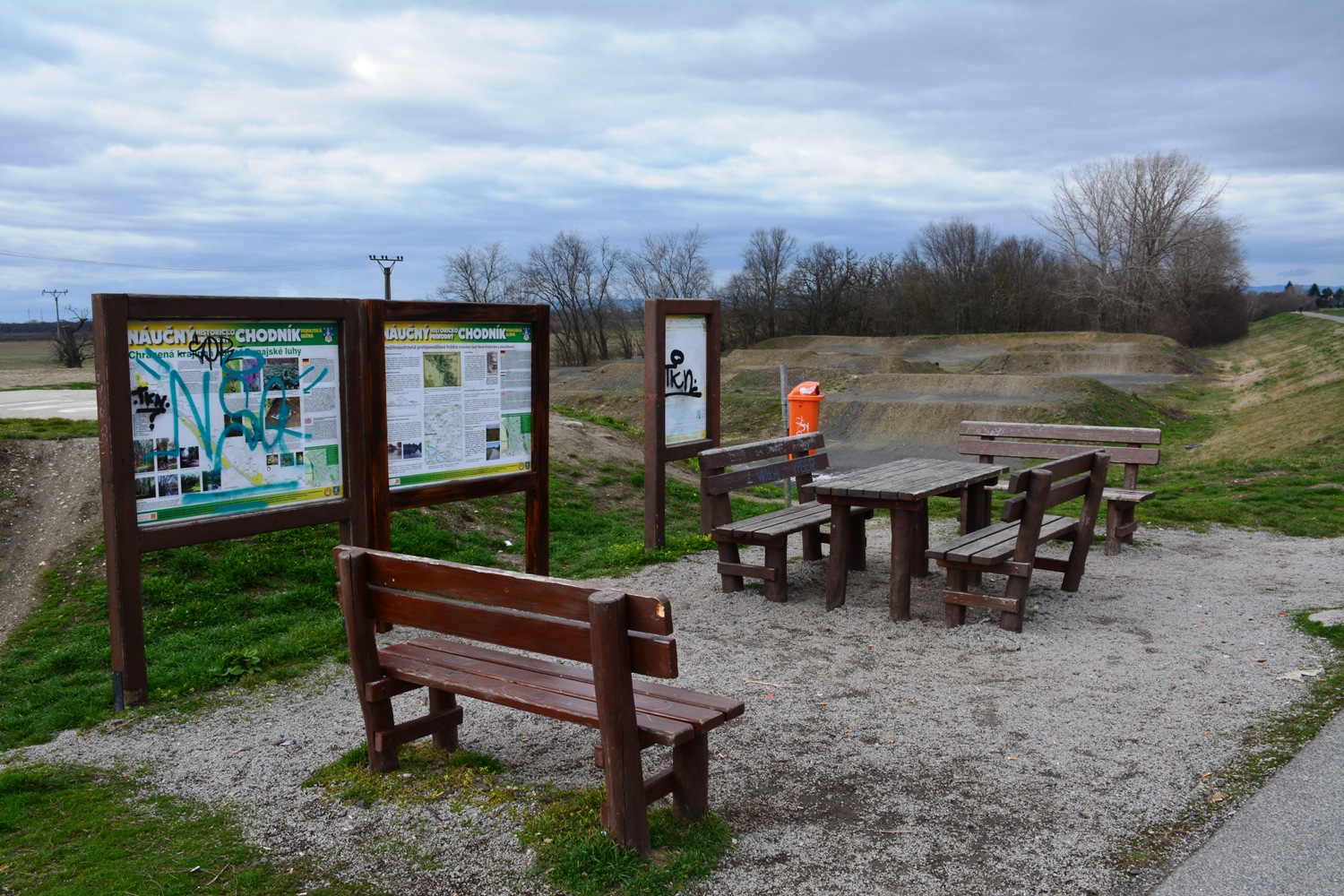
The educational trail in Dunajská Lužná was established in 2011 and consists of information panels located at 14 different sites throughout the village. The panels provide information in four languages (Slovak, Hungarian, German, and English) regarding the history as well as the cultural and natural treasures of the municipality.
The starting point of the trail is located in front of the local Cultural Center on St. Martin’s Square (Námestie sv. Martina). The route continues through Košariská Street, Main Street (Hlavná ulica), Jánošíkovská Street, and along the Upper Žitný Ostrov embankment, ending at Lipnická Street.
During the walk, visitors can learn about the princely burial mounds and the settlement nearby, the Evangelical Church, St. Martin’s Chapel, and the Roman Catholic Church of the Exaltation of the Holy Cross. The panels also cover the tradition of the blacksmithing craft, the village symbols, the Danube Floodplains Protected Landscape Area (CHKO Dunajské luhy), and the Upper Žitný Ostrov embankment. The final, eccentrically located stop of the trail is the Neo-Gothic belfry in the Nová Lipnica district.
The educational trail is free and accessible to the general public throughout the year, and it is also highly suitable for school field trips and outdoor education.
The municipality of Dunajská Lužná was established on January 1, 1974, through the merger of three originally independent villages: Jánošíková, Nová Lipnica, and Nové Košariská.
The village of Nové Košariská (formerly German Mischdorf, Hungarian Misérd) was already in existence by 1206. It is well-known in European archaeology for its princely burial mounds dating back to the Early Iron Age—specifically the Hallstatt period (700–550 BC).
The village of Jánošíková (formerly Germ. Schildern, Hung. Dénesd) likely also existed at the beginning of the 13th century. It is first mentioned in 1240, when it belonged to the Bratislava Castle. In 1258, it came under the jurisdiction of the Benedictine Abbey at St. Martin’s Hill (known as Pannonhalma in northern Hungary).
The village of Nová Lipnica (formerly Germ. Tartschendorf, Hung. Torcs) was first mentioned in 1230. Until recently, traditional clay houses dating from the late 19th and early 20th centuries could still be found there.
The municipality of Dunajská Lužná is renowned in European archaeology for its significant tumulus burial ground dating back to the Early Iron Age (the Hallstatt period), from 700–550 BC. This archaeological site consists of Hallstatt-era burial mounds containing rare ritual ceramics.
Through comprehensive archaeological research in the Nové Košariská district, a tumulus necropolis was systematically explored. The site features a cremation burial method, with central graves located within earthen mounds.
The findings from the research conducted between 1960 and 1967, during which five Hallstatt mounds were examined, are preserved in the Slovak National Museum – Archaeological Museum in Bratislava.
On September 16, 2000, an exhibition titled "Princely Burial Mounds from the Early Iron Age (700 to 550 BC)" was ceremoniously opened at the local Cultural Center in Nové Košariská.
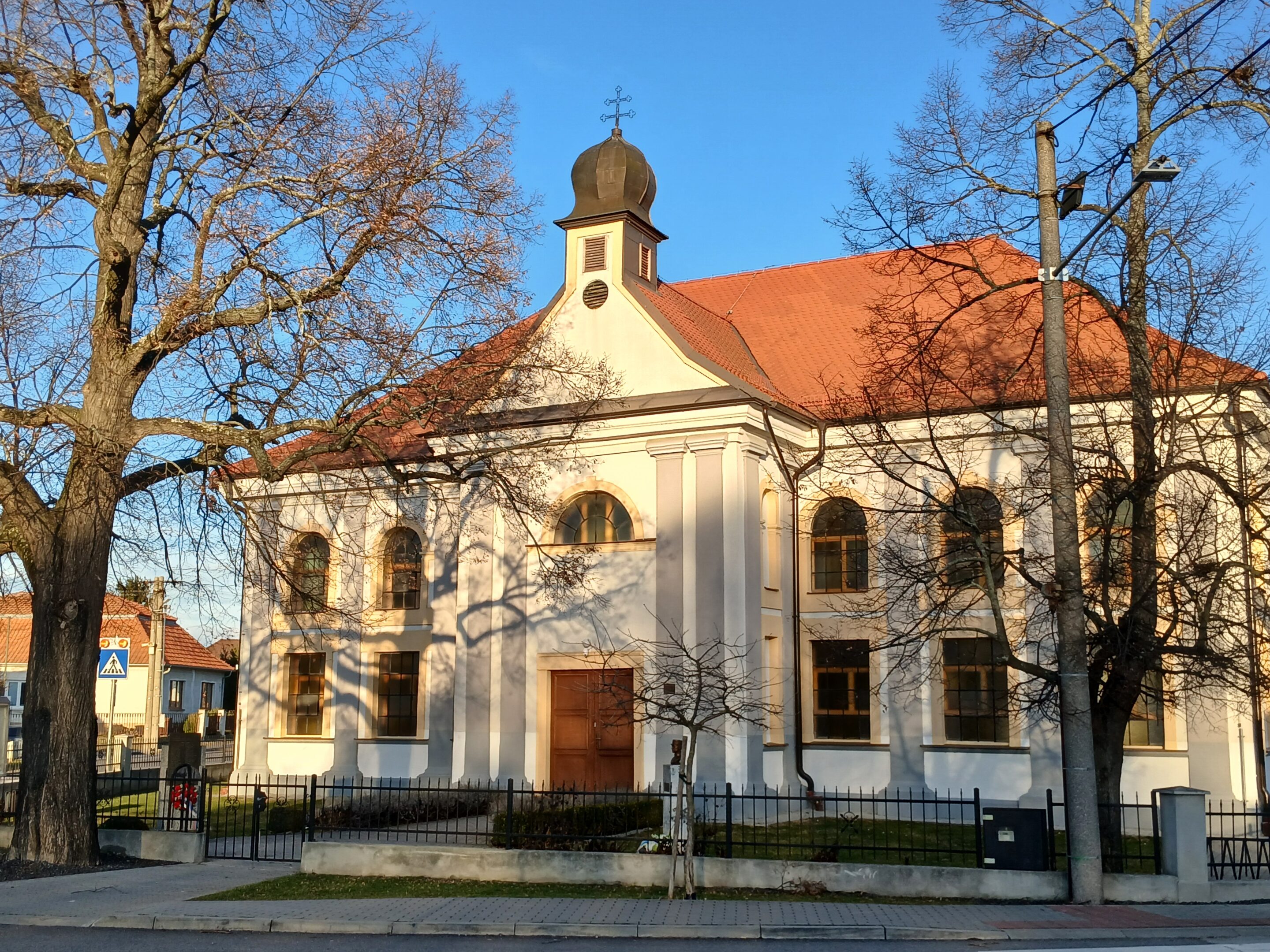
The church was built in 1814 and belongs to the wave of Lutheran churches constructed following the issuance of the Patent of Toleration in 1781. It was designed in the Neoclassical style, which is characterized by the artistic ideals of antiquity—namely order and austerity. The building features an elongated floor plan and, for that era, an unusually situated altar located directly opposite the main entrance.
The interior of the church houses a wooden altar featuring a painting of the suffering Christ on the Cross. Above the altar, there is a pulpit topped with a canopy.
A memorial plaque dedicated to the unique personality of the Slovak nation—French General, politician, statesman, and co-founder of the first Czechoslovak Republic—was erected in 1992. Originally located inside the Lutheran Church of the Augsburg Confession, it was moved to its current position in front of the church in 1998.
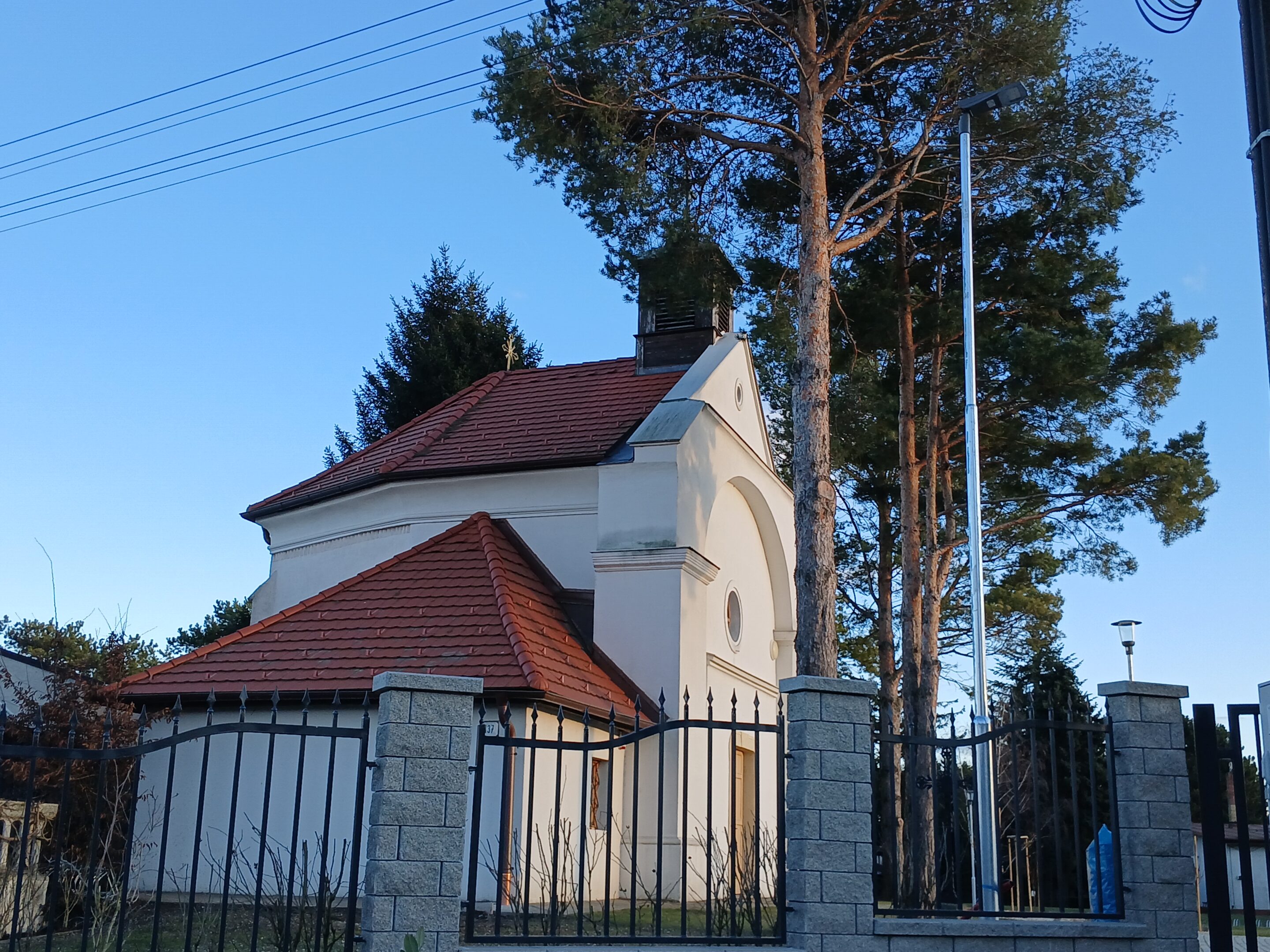
The church was built around the 12th–13th century using stone and partially fired brick, and was dedicated to St. Martin. Originally constructed in the Gothic style, it was later remodeled in the Baroque style. A tower, built entirely of stone, was added to the church. Records from 1736 indicate repairs to the tower and likely minor adjustments to the church itself. A major reconstruction took place between 1773 and 1774, during which the church was converted into a Baroque structure.
Immediately adjacent to the church was the original cemetery, which remained in use until 1773. After a fire in 1852, the church gradually fell into disrepair. Only the presbytery of the original building was structurally preserved and modified into the small chapel that stands today. In 1963, the chapel was officially declared a cultural monument.
The village of Dunajská Lužná (specifically the Nové Košariská district), which earned the nickname "the Iron Village" in the 1970s, has been renowned for its blacksmith workshops and skilled masters since the distant past. Members of the Roma community settled in the territory of Nové Košariská at the beginning of the 18th century, dedicating themselves to blacksmithing—shoeing horses and manufacturing nails, tacks, and essential tools for farmers. In the second half of the 20th century, they enriched the craft by incorporating elements of artistic blacksmithing and locksmithing.
Today, there are approximately 10 workshops in the village continuing a blacksmithing tradition that spans more than 300 years. On September 18, 1999, the Hefaiston Blacksmith’s Yard was opened. Located in the center of the village on St. Martin’s Square, it represents the first permanent open-air exhibition of artistic blacksmithing in Slovakia.
After 1990, the municipality of Dunajská Lužná faced the challenge of creating unified symbols for the three originally independent villages: Jánošíková, Nová Lipnica, and Nové Košariská. The municipality ultimately decided to adopt the emblem from the seal of the village of Mischdorf (today the district of Nové Košariská) as its coat of arms.
The coat of arms of Dunajská Lužná depicts St. Martin, the patron saint of the church in the Mischdorf district.
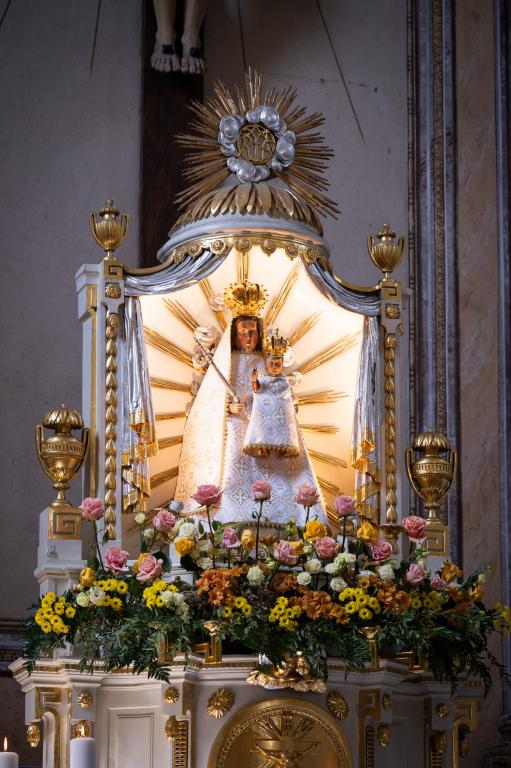
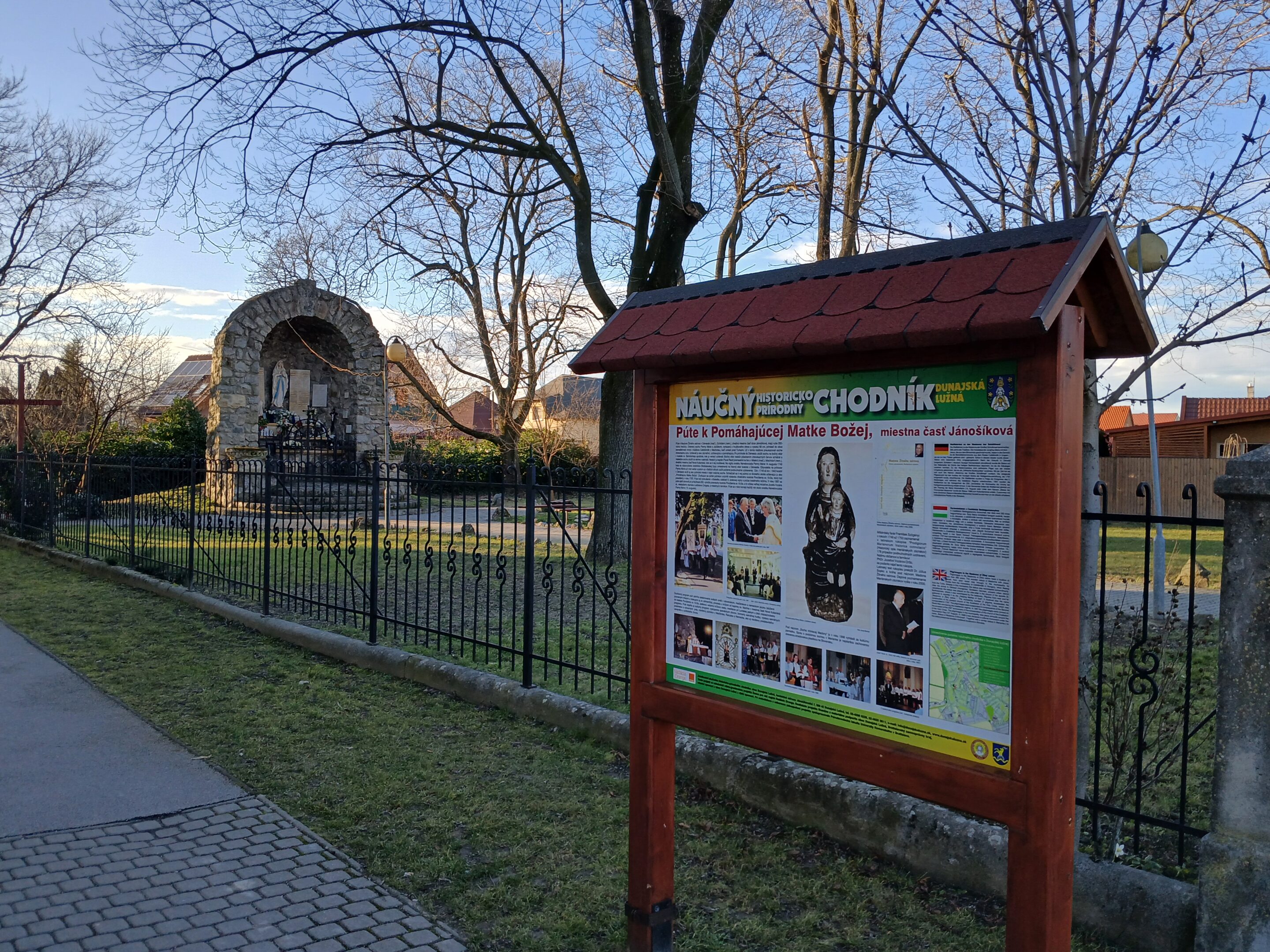
The high altar of the Pilgrimage Church of the Exaltation of the Holy Cross in Dunajská Lužná (formerly Dénesd) features a wooden statue of the Blessed Virgin Mary with the Infant Jesus. It was crafted in the 12th or 13th century, likely in the southern Italian provinces of Molise and Abruzzo. Numerous remarkable legends regarding the healing of the sick are associated with the statue, leading people to call her the "Helping Mother of God."
The statue was brought to the village by Benedictine monks from the Celldömölk monastery in Hungary while they were fleeing from the Turks. In 1749, the statue was moved to the church's high altar. Since then, pilgrims from the surrounding regions have gathered here to venerate her as the "Helping Mother of God," and she has also earned the title "Madonna of Žitný Ostrov."
In the 13th century, the Abbot of the Benedictine Abbey at St. Martin's Hill (Pannonhalma) ordered the construction of a church in Dénesd, which was originally dedicated to St. Bartholomew. During the period of religious conflict in the 17th century, it also served as a parish church (1684).
The building was consecrated as the Church of the Exaltation of the Holy Cross in 1797. As one of the most significant historical landmarks in the municipality, it was officially declared a cultural monument in 1963.
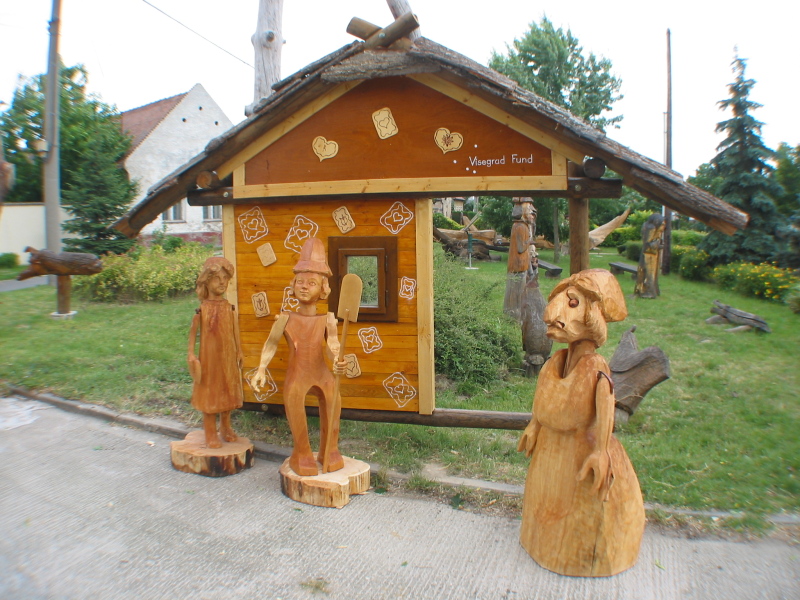
Fairytales serve as a unique form of human education—capturing life in all its beauty and simplicity. It is in this spirit that the now-traditional international woodcarving symposia are held in Dunajská Lužná.
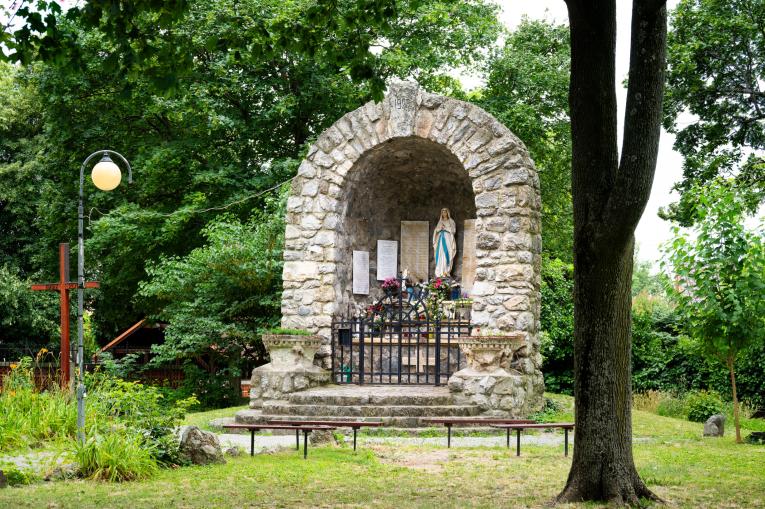
The initiative began in 2001, when Juraj Mertuš crafted a small shrine within the fence of his family home to house his own statue of Our Lady of Sorrows. Later, in cooperation with the municipality of Dunajská Lužná, he began inviting fellow woodcarvers—both local and from abroad—to contribute their works, gradually transforming the space into a public Gallery.
The village settlement is situated at an altitude of 126–130 meters within the geographical unit of the Danubian Lowland, in the northwestern part of Žitný ostrov. The municipality ranks among the areas with the lowest forest coverage in Slovakia. The predominant composition of local woodlands consists of grey poplar, white willow, European ash, and field elm.
From a zoogeographical perspective, the territory is influenced by both the Pannonian Basin and the Alpine system, connected via the Danube River. The area is characterized by high biodiversity, featuring numerous rare and endangered invertebrate species, such as mollusks, crustaceans, dragonflies, and beetles. Among small mammals, the relict occurrence of the root vole (Microtus oeconomus) on Žitný ostrov is particularly significant.
The Danube and its branches host the highest number of fish species of all watercourses in SK. This group of animals was most significantly affected by the construction of the Gabčíkovo Waterworks.
The construction of local flood protection embankments on the territory of Žitný ostrov has been documented since the 13th century. In 1569, a law was enacted mandating the repair of old levees and the construction of new ones. The most intensive structural development of the Upper Žitný Ostrov protective embankment is documented primarily from the mid-19th century onwards.
The preserved form of the embankment today has a total width of 40 meters and a height of 6 meters. Following the commissioning of the Gabčíkovo Waterworks in 1992, this specific levee became redundant, and its primary function was taken over by the left-bank embankment of the Hrušov reservoir.
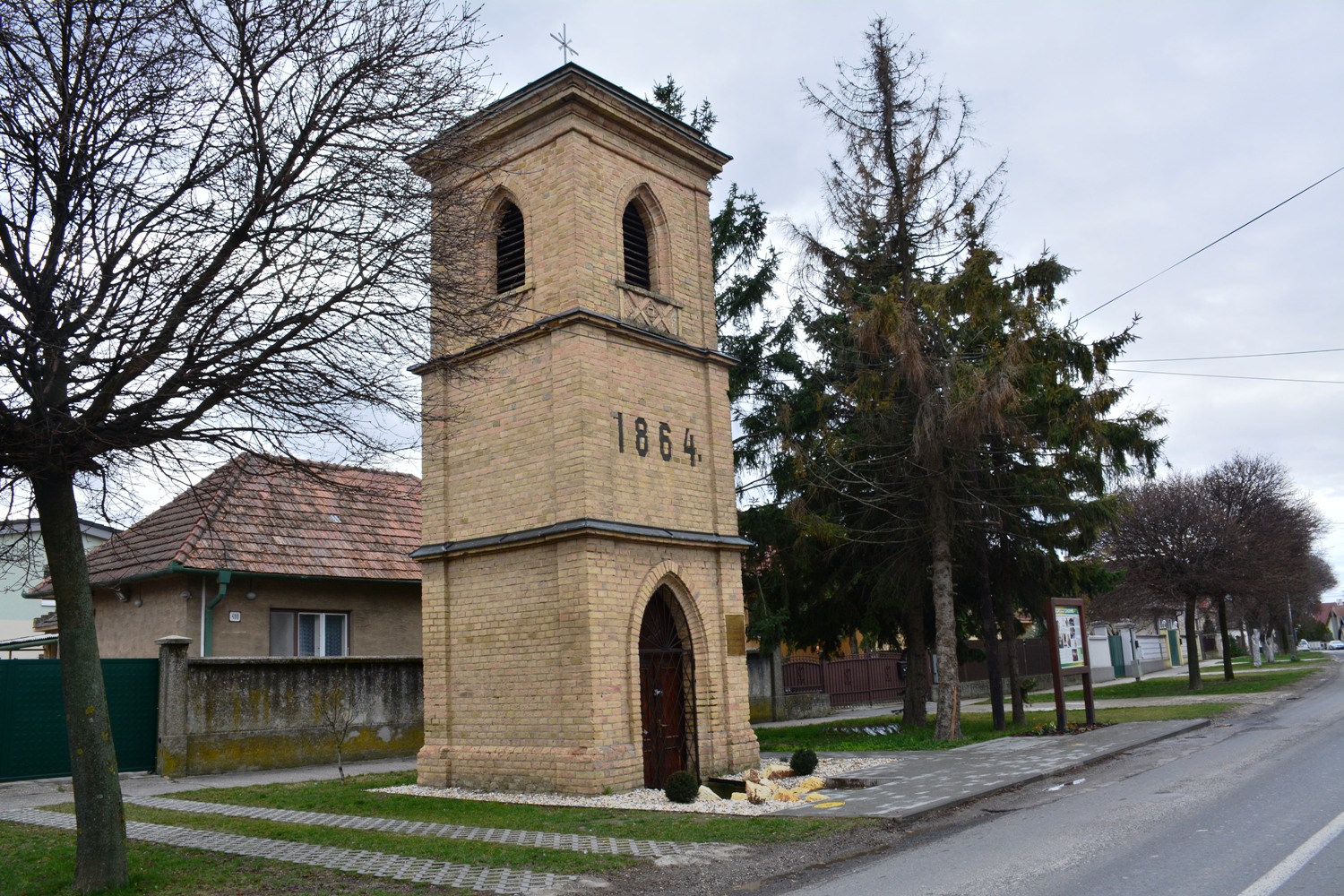
The bell tower was built in the Neo-Gothic style in 1864. Although written records have not been preserved, local oral tradition holds that the tower was commissioned by the Counts Pálffy and Apponyi, who owned the majority of the village at that time. The bell tower in Nová Lipnica houses two bells: a large one and a small one.